
Harm OCD is one of the most frightening forms of obsessive-compulsive disorder because it targets what matters most to you: your safety, your values, and the people you love. The thoughts can feel shocking, urgent, and deeply convincing even when they go completely against who you are.
If you are dealing with intrusive harm thoughts, you may find yourself asking questions like: “What if I lose control?” “What if this means something about me?” or “Why would my mind even produce this?” These questions feel serious, but in Harm OCD they often pull people deeper into fear, checking, and reassurance seeking rather than toward relief. This page stays focused on the harm theme specifically. If you want a broader foundation first, our article on intrusive thoughts can help.
What Is Harm OCD?
Harm OCD is a subtype of Obsessive-Compulsive Disorder where a person experiences intrusive, unwanted thoughts about causing harm to themselves or others. Unlike a broad article on intrusive thoughts, the focus here is on how fear of harm becomes its own OCD loop.
These thoughts can include:
- “What if I stab someone?”
- “What if I lose control and hurt my loved ones?”
- “What if I snap and do something terrible?”
- “What if I want to hurt myself?”
The key distinction is this: these thoughts are ego-dystonic, which means they go against who you are and what you value.
Harm OCD involves intrusive, unwanted thoughts about causing harm that feel deeply upsetting and conflict with a person’s values.
People with Harm OCD are often:
- highly empathetic
- morally conscientious
- deeply afraid of causing harm
The fact that these thoughts disturb you is usually part of the pattern, not evidence that you are dangerous.
Why Do These Thoughts Feel So Real?
Harm OCD is driven by several overlapping processes:
1. Intrusive Thoughts
Everyone has strange or disturbing mental noise from time to time. The difference in Harm OCD is that the mind locks onto harm-themed content and treats it like a threat that must be solved immediately.
2. Inflated Responsibility
You may feel like it is your job to prevent harm at all costs, or that even having the thought means you need to act immediately to make sure nothing bad happens.
3. Thought-Action Fusion
This is the belief that thinking something means you are capable of doing it, or that thinking it somehow makes it more likely to happen.
4. Intolerance of Uncertainty
You may feel like you need 100% certainty that you will never harm anyone and that you are unquestionably a “good person.” OCD keeps asking, “But what if you are wrong?”
Common Compulsions in Harm OCD
To reduce anxiety, people often engage in compulsions such as:
- avoiding knives, sharp objects, or loved ones
- seeking reassurance like “I would never do that, right?”
- mentally reviewing past behavior
- checking internal feelings to see whether they feel dangerous
- Googling symptoms, stories, or signs of violence
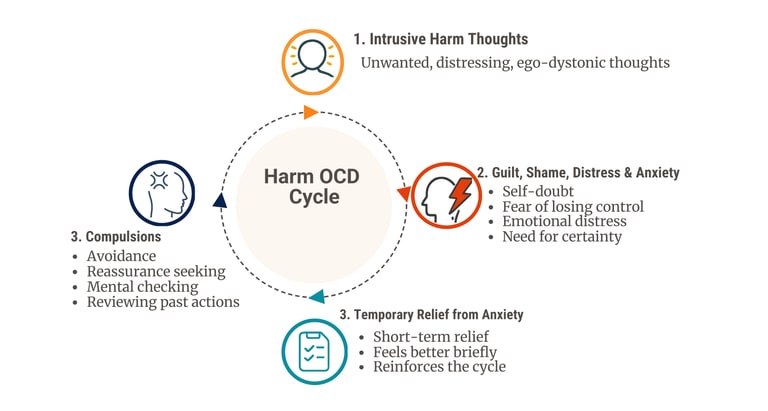
These responses often create brief relief, but they teach the brain that the thought really was dangerous. That is what keeps the cycle going. If that pattern feels familiar, it often overlaps with rumination, reassurance-seeking OCD, and urgency around intrusive thoughts.
The OCD Cycle (Why It Keeps Coming Back)
- Intrusive thought
- Anxiety
- Compulsion
- Temporary relief
- Stronger OCD next time
This loop reinforces the idea that the thought is dangerous and must be handled every time it appears.
What Harm OCD Is Not
Let’s be clear:
- It is not a desire to harm
- It is not a hidden impulse
- It is not predictive of violent behavior
In fact, people with Harm OCD are typically deeply distressed by these thoughts precisely because they do not want them and do not identify with them.
Why Avoidance Makes It Worse
Avoidance teaches your brain, “This thought is dangerous.” In response, your brain sends more thoughts, increases anxiety, and expands the list of triggers. Over time, your world can become smaller and more restricted.
The Most Effective Treatment: ERP Therapy
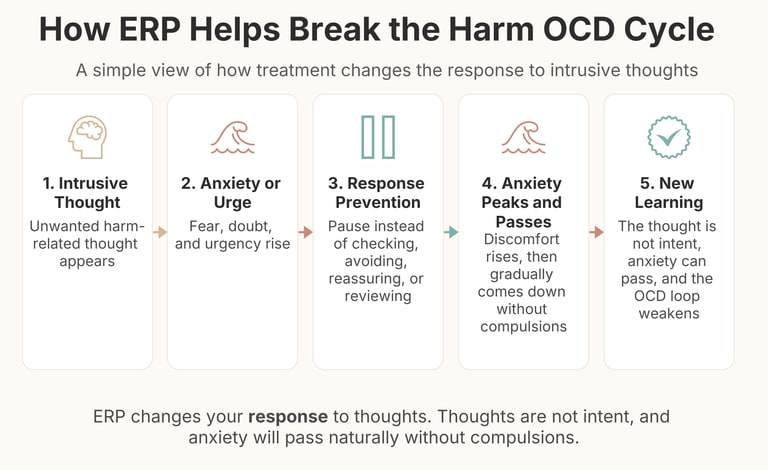
The gold standard treatment for Harm OCD is Exposure and Response Prevention (ERP). ERP works by gradually targeting the fear-of-harm loop while helping you resist the compulsions that keep OCD alive.
ERP helps people learn that thoughts are not emergencies, not commands, and not signs of intent. If you are looking for specialized care, OCD therapy focused on ERP can help you respond differently to intrusive harm thoughts over time. If you want a more general explanation of how ERP works as a method, our dedicated ERP therapy page breaks that down separately.
Example ERP Exercises for Harm OCD
- holding a knife while noticing intrusive thoughts without neutralizing them
- writing feared scenarios without trying to cancel them out
- sitting with uncertainty instead of trying to get total reassurance
Over time, ERP helps anxiety decrease, thoughts lose meaning, and confidence return.
Key Insight: Thoughts Are Not Intentions
One of the most important shifts in recovery is realizing that a thought is just a thought. It is not a signal, not a command, and not a truth. Trying to “figure it out” keeps you stuck. Learning to allow uncertainty is what begins to set you free.
When to Seek Help
It may be time to seek help if you:
- feel trapped in intrusive harm thoughts
- avoid people or objects out of fear
- spend hours analyzing your thoughts
- constantly seek reassurance
If you are still sorting out whether your symptoms fit anxiety, OCD, or both, our page on anxiety and OCD offers a broader overview of how those patterns can overlap.
You Are Not Your Thoughts
Harm OCD attacks what you value most. That is why it feels so convincing. But the very fact that these thoughts disturb you is often the strongest evidence of who you really are.
At EK Mental Health Counseling, we provide compassionate, evidence-based care for OCD and related anxiety patterns. You do not have to keep organizing your life around fear, checking, or avoidance.
Frequently Asked Questions About Harm OCD
Can people with Harm OCD act on their thoughts?
No. These thoughts are unwanted and inconsistent with the person’s values.
Why do the thoughts feel so real?
Because OCD attaches meaning, urgency, and responsibility to them, which increases anxiety and attention.
Should I try to stop the thoughts?
No. Suppressing or fighting the thoughts usually keeps them more active. ERP helps you respond differently instead.
Is medication helpful?
In some cases, SSRIs can help reduce OCD symptoms, especially when combined with ERP therapy.
Get Help for Harm OCD
If intrusive harm thoughts are pulling you into fear, avoidance, or repeated mental checking, support is available. Therapy can help you understand the pattern and build a more grounded response.
Related OCD Topics
These pages can help if harm fears overlap with mental reviewing, reassurance, or confusion about what intrusive thoughts mean.