

If you are trying to understand how to stop seeking reassurance in OCD, you are not alone. Reassurance can feel calming in the moment. It may seem like the fastest way to quiet doubt, reduce anxiety, or feel sure that nothing is wrong. But when reassurance becomes part of OCD, it usually brings only brief relief before the fear returns again.
That is one reason reassurance seeking OCD can feel so draining. You may ask the same question in different ways, search online for certainty, replay past events, or look to other people to help you feel safe. The problem is not that you want comfort. The problem is that OCD can turn reassurance into a compulsion. Effective treatment is available, and it is possible to learn a different response.
What reassurance seeking looks like in OCD
Reassurance seeking in OCD is any repeated attempt to get certainty, relief, or emotional safety from a fear that OCD keeps bringing back. Sometimes it looks obvious. Sometimes it is subtle.
Examples can include:
- asking a partner, friend, or therapist the same question over and over
- repeating “Are you sure?” after already getting an answer
- confessing thoughts, doubts, or memories to feel relieved
- searching online for proof that a fear is not true
- re-reading messages, notes, or past events to feel certain
- checking your own reactions, feelings, or body sensations for reassurance
- mentally reviewing whether you did something wrong
For some people, this pattern is closely tied to intrusive thoughts. A thought shows up, anxiety rises, and the urge to get certainty can feel immediate and urgent.
Is reassurance seeking a compulsion?
Often, yes.
In OCD, a compulsion is something a person does to reduce distress, prevent harm, or feel certain after an obsession or intrusive fear appears. Reassurance seeking can work exactly that way. A person may ask a loved one, search online, confess, or check internally because the mind is trying to feel safe right now.
This is one reason reassurance seeking often overlaps with mental compulsions in OCD. Even if the compulsion is not visible to other people, the internal loop can still be very active.
The goal of reassurance is usually not information. It is relief. That is what makes it so sticky in OCD.
Why reassurance feels helpful in the moment
Reassurance usually works for a short time. That is why it can be so tempting.
When anxiety rises, reassurance can create a quick drop in distress. You may feel calmer, lighter, or more grounded for a moment. OCD learns from that relief and starts treating reassurance like a safety behavior that must happen again the next time doubt appears.
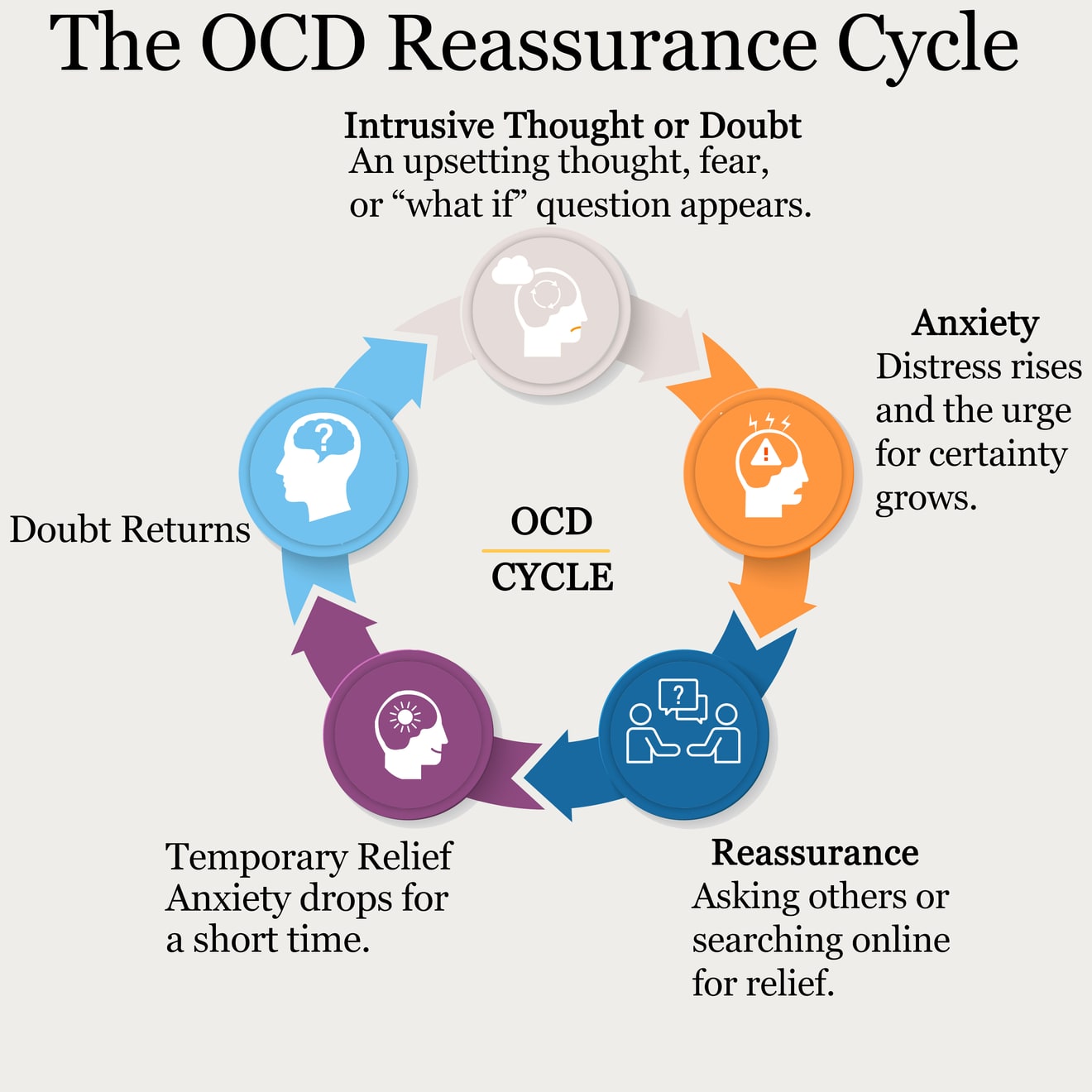
The reassurance cycle
- An intrusive thought, doubt, or fear appears.
- Anxiety rises.
- You ask, check, confess, or search for reassurance.
- Relief comes briefly.
- The doubt returns.
- The urge to seek reassurance gets stronger.
This is one reason OCD and uncertainty are so closely linked. The brain starts acting as if uncertainty is dangerous and must be solved every time.
Why reassurance makes OCD worse over time
Reassurance usually does not solve the real problem in OCD. OCD is not actually asking for useful information. It is asking for certainty, and certainty is exactly what OCD keeps demanding more of.
When reassurance becomes a regular response, several things often happen:
- your tolerance for uncertainty gets weaker
- the fear starts to feel more important
- the same question no longer feels answered for very long
- loved ones may start feeling confused, pressured, or drained
- shame can grow because you know the reassurance does not really last
If the cycle feels mostly internal, it may also overlap with rumination, replaying conversations, or trying to prove to yourself that a fear is not true.
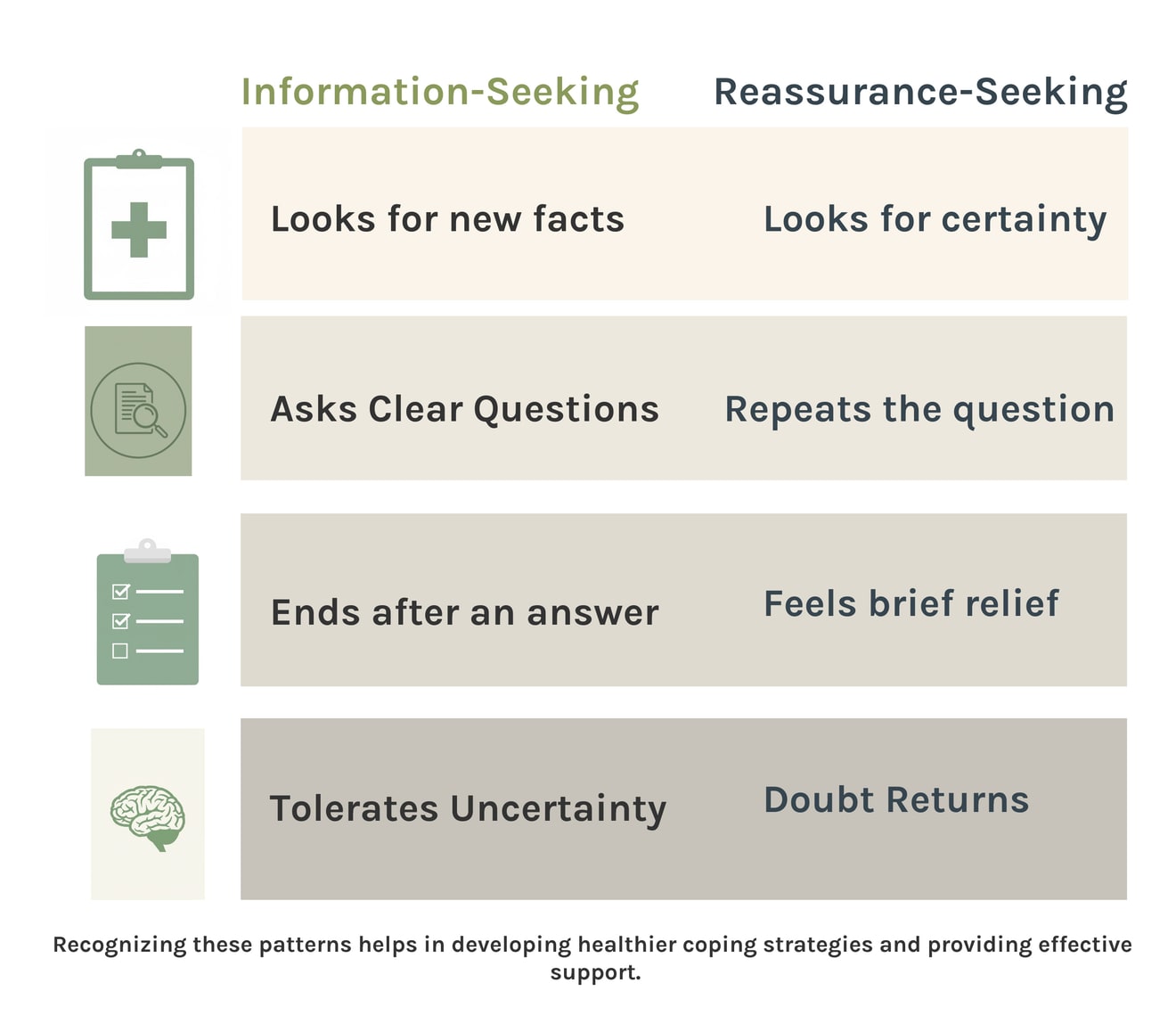
How to tell if you are seeking information or seeking relief
Sometimes people do need real information. But in OCD, the urge often has a different purpose.
You may be seeking reassurance if:
- you already know the answer, but it does not feel like enough
- you ask the same question repeatedly
- you want the answer delivered in a very specific way
- the relief fades quickly
- you feel a strong urge to ask “just one more time”
- the question is really about feeling certain, innocent, safe, or in control
A helpful check is: Am I asking because I need new information, or because I need relief right now?
Common forms of reassurance seeking OCD
Reassurance seeking does not look the same for everyone. It may show up in different OCD themes.
Relationship OCD
A person may ask whether they really love their partner, whether the relationship is “right,” or whether a feeling means something important. The relief tends to be short-lived.
Harm-related OCD
A person may ask whether having a thought means they are dangerous or likely to act on it. In these cases, intrusive thoughts do not reflect intent. The urge to ask is often part of the OCD cycle, not evidence of risk.
Guilt and moral doubt
A person may repeatedly ask whether they did something wrong, whether they should confess, or whether they are a bad person. In these cases, reassurance often feeds the cycle rather than resolving it.
Health and body-based fears
Some people repeatedly ask for confirmation about symptoms, sensations, or illness fears. In some cases, that overlaps with generalized anxiety. If you are trying to sort out the difference, our page on OCD vs GAD: how to tell the difference may help.
How to stop reassurance seeking in OCD
Learning how to stop reassurance seeking does not mean becoming cold, reckless, or unsupported. It means changing your response to OCD so the cycle loses strength over time.
-
1. Start by naming the pattern
The first step is recognizing reassurance as reassurance. Try saying to yourself, “This may be OCD asking for relief,” or “I notice the urge for certainty right now.”
-
2. Delay the urge
You do not have to stop perfectly all at once. Try delaying reassurance by two minutes, then ten, then longer. Even delaying weakens the automatic link between anxiety and reassurance.
-
3. Reduce the number of times you ask
If you usually ask five times, try asking four. Then three. Then one. A gradual reduction often feels more workable than demanding total perfection right away.
-
4. Practice allowing uncertainty
You may need to say, “Maybe, maybe not,” or “I do not get to feel fully certain right now.” The goal is not to feel immediately calm. The goal is to stop feeding the cycle.
-
5. Stop seeking reassurance from yourself too
If you stop asking other people but keep mentally checking, reviewing, or self-soothing through analysis, OCD may simply shift form.
What to say instead of asking for reassurance
It can help to replace the old pattern with language that supports the new one. You might try:
- “I notice I want reassurance right now.”
- “I want relief, but I do not want to feed OCD.”
- “I can handle this uncertainty for a few minutes.”
- “Can you sit with me without answering the question?”
- “I am practicing not solving this right away.”
What loved ones can say instead
Family members and partners often want to help, which makes sense. But repeated reassurance can unintentionally become part of the OCD cycle.
More supportive responses may sound like:
- “I can see that you are anxious right now.”
- “I care about you, and I do not want to feed OCD.”
- “I am here with you, even if I do not answer that question.”
- “What would it look like to let the uncertainty be there?”
This kind of support can be especially helpful in OCD therapy, where the goal is not to remove all discomfort but to change the response to it.
How Exposure and Response Prevention helps with reassurance seeking
Exposure and Response Prevention (ERP) is one of the most established evidence-based treatments for OCD.
With reassurance-seeking OCD, ERP often involves noticing the trigger, allowing anxiety or doubt to rise, and resisting the urge to ask, check, confess, or review. Over time, the brain learns that distress can rise and fall without a compulsion being used to neutralize it.
- not asking a partner for repeated confirmation
- not checking online for proof
- not replaying an event to feel certain
- not asking whether an intrusive thought means something important
If reassurance seeking is playing a large role in your symptoms, specialized OCD therapy can help you build these skills in a structured and compassionate way. If you are also sorting through overlapping worry, our page on anxiety and OCD treatment may help clarify how these patterns interact.
When reassurance should not be withheld
Not every situation is an OCD situation. Real emergencies, immediate safety concerns, and urgent mental health crises should be treated as real safety issues. The goal is not to deny support. The goal is to avoid reinforcing compulsions when OCD is driving the urge.
When to reach out for support
It may be a good time to reach out if reassurance is taking up a lot of time, your relationships are getting strained, you feel stuck in the same loops every day, or you know reassurance is not helping but still feel unable to stop.
You are not alone, and effective treatment is available. A therapist who understands OCD can help you respond differently to doubt without feeding the cycle.
Frequently Asked Questions About Reassurance Seeking in OCD
Is reassurance seeking a compulsion in OCD?
Yes. In OCD, reassurance seeking often functions like a compulsion because it is used to reduce anxiety, get certainty, or neutralize a fear.
Why does reassurance make OCD worse?
Reassurance may help briefly, but it teaches the brain that uncertainty is dangerous and must be solved right away.
Can reassurance seeking happen mentally?
Yes. Some people seek reassurance from others, while others do it internally through reviewing, replaying, checking, or arguing with thoughts.
Can ERP help with reassurance-seeking OCD?
Yes. ERP can help people change how they respond to uncertainty, intrusive thoughts, and reassurance-seeking compulsions over time.
Related OCD Topics
These pages can help if reassurance-seeking overlaps with intrusive thoughts, rumination, uncertainty, or mental checking.