
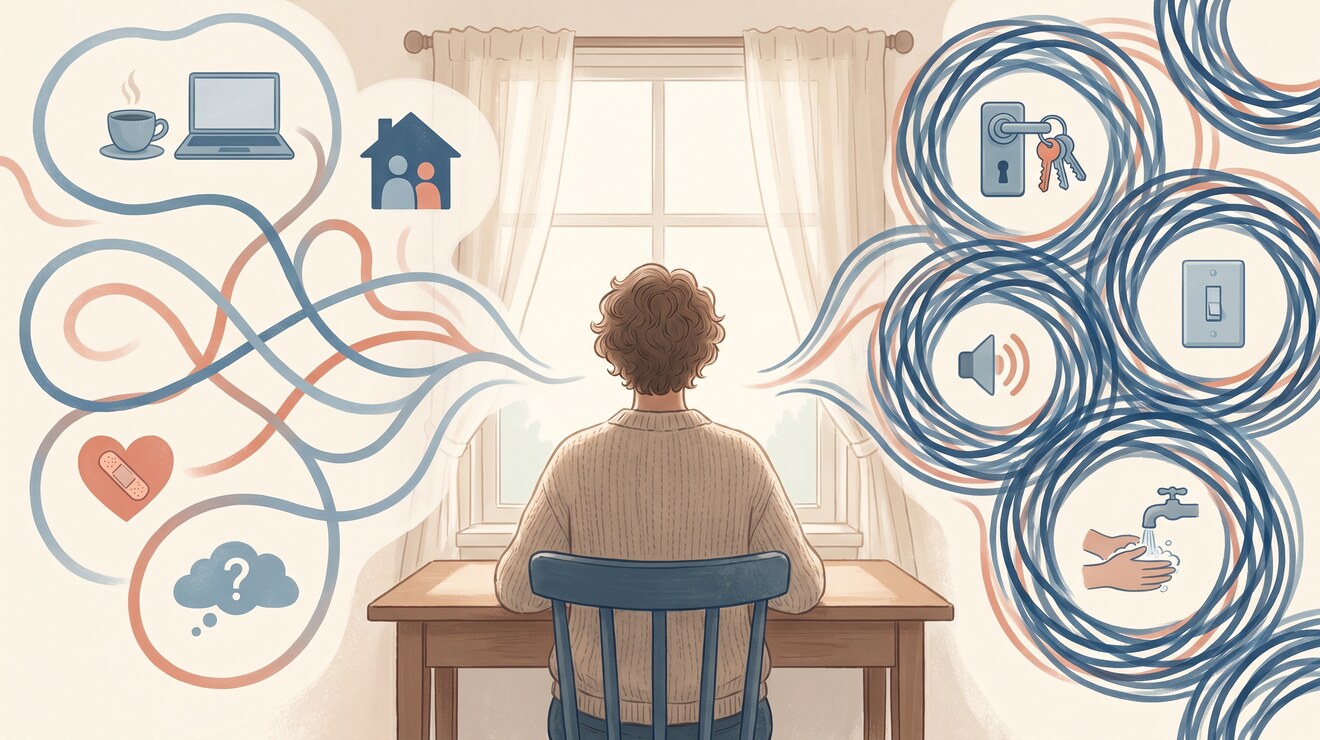
Generalized Anxiety Disorder (GAD) and Obsessive-Compulsive Disorder (OCD) can both involve intense anxiety, racing thoughts, difficulty sleeping, and a sense that your mind will not quiet down. Because they can feel similar from the inside, many people wonder whether they are experiencing anxiety, OCD, or both.
Although GAD and OCD can overlap, they are not the same condition. GAD is usually marked by ongoing, difficult-to-control worry about many areas of life, such as health, work, family, relationships, finances, responsibilities, or the future. OCD is usually marked by intrusive thoughts, images, urges, or doubts, followed by compulsions or avoidance meant to reduce distress or prevent something feared from happening.
Understanding the difference matters because treatment is most helpful when it matches the pattern you are experiencing. If the main issue is generalized worry, anxiety-focused therapy may help you relate differently to uncertainty and reduce the hold worry has on your life. If the main issue is OCD, treatment often needs to focus on the cycle of obsessions and compulsions, usually through Exposure and Response Prevention (ERP).
What Generalized Anxiety Disorder Can Feel Like
Everyone worries sometimes. Worry can even be useful when it helps us prepare, solve a problem, or respond to something important. With GAD, though, worry becomes persistent, exhausting, and difficult to control.
A person with GAD may worry about many things at once. They may think about whether something bad will happen to a loved one, whether they made a mistake at work, whether their health symptoms mean something serious, whether they are falling behind, or whether they are prepared enough for the future.
Even when there is no immediate crisis, the body may feel tense and the mind may keep scanning for what could go wrong.
Common symptoms of GAD can include:
- Feeling restless, keyed up, or on edge
- Difficulty sleeping or waking during the night
- Fatigue or feeling mentally drained
- Trouble concentrating
- Irritability or impatience
- Muscle tension, headaches, or stomach discomfort
- Difficulty relaxing, even when things are going well
One difficult part of GAD is that people can begin to worry about the worry itself. They may think, “Why can’t I stop thinking about this?” or “What if my anxiety means I’m missing something important?” Over time, this cycle can make daily life feel smaller, heavier, and harder to enjoy.
What OCD Can Feel Like
OCD is often misunderstood as simply liking things clean, organized, or done a certain way. In reality, OCD is much more distressing than that.
OCD involves obsessions and compulsions. Obsessions are intrusive, unwanted thoughts, images, urges, or doubts that create anxiety, shame, guilt, or fear. Compulsions are behaviors or mental actions a person uses to try to reduce that distress, gain certainty, or prevent a feared outcome.
Obsessions can focus on many themes, including contamination, harm, health, relationships, morality, religion, responsibility, sexuality, or the fear of making a mistake. Compulsions can be visible, such as washing, checking, repeating, counting, arranging, or asking for reassurance. They can also be internal, such as mentally reviewing events, neutralizing thoughts, praying in a rigid way, repeating phrases, or trying to “figure out” whether a thought means something.
Compulsions may bring short-term relief, but that relief usually does not last. The doubt returns, the anxiety rises again, and the person may feel pulled back into the cycle.
The Key Difference Between GAD and OCD
The simplest way to understand the difference is this:
GAD tends to involve broad, persistent worry about real-life concerns. OCD tends to involve intrusive obsessions and compulsions aimed at reducing fear, doubt, or uncertainty.
For example, someone with GAD may worry throughout the day about health, work, family, money, and the future. Someone with OCD may become stuck on a specific intrusive fear, such as “What if I contaminated someone?” or “What if I hurt someone and don’t remember?” and then feel driven to check, clean, avoid, review, confess, or seek reassurance.
That said, the difference is not always perfectly neat. People with GAD may seek reassurance. People with OCD may experience generalized anxiety between obsessions. Some people experience both conditions at the same time. This is one reason a thoughtful assessment with a mental health professional can be so helpful.
How GAD Is Treated
Treatment for GAD often focuses on changing the relationship a person has with worry and uncertainty.
Cognitive Behavioral Therapy (CBT) can help people notice anxious predictions, challenge unhelpful thinking patterns, and develop more flexible ways of responding to stress. Acceptance and Commitment Therapy (ACT), mindfulness-based approaches, relaxation skills, sleep support, and lifestyle changes may also be helpful.
Medication can also be part of treatment for some people. SSRIs and SNRIs are commonly used for anxiety disorders, and medication decisions should always be made with a qualified prescribing professional who understands your symptoms, medical history, and needs.
The goal of treatment is not to eliminate every anxious thought. The goal is to help worry become less dominant, less disruptive, and less in charge of how you live.
How OCD Is Treated
For OCD, the treatment approach is usually more specific. The gold-standard therapy for OCD is Exposure and Response Prevention, often called ERP.
ERP is a specialized form of CBT that helps people gradually face triggers while resisting compulsions. Over time, the brain learns that anxiety can rise and fall without rituals, avoidance, reassurance, or mental checking.
This can sound intimidating at first, especially if compulsions have been the main way a person has coped with fear. Good ERP is collaborative and paced thoughtfully. It is not about forcing someone into situations they are not ready for. It is about helping them build confidence, flexibility, and freedom from OCD’s rules.
Medication may also help some people with OCD, especially SSRIs or other medications recommended by a qualified prescriber. Many people benefit from a combination of ERP, medication support, education, and family involvement.
When GAD and OCD Happen Together
It is possible to have both GAD and OCD. A person may worry broadly about work, health, and family while also experiencing intrusive thoughts and rituals connected to OCD.
For example, someone may worry about their health in a generalized way, but also compulsively check their body, search symptoms online, or seek reassurance to neutralize a specific obsession. In this case, treatment may need to address both the generalized worry and the compulsive cycle.
When GAD and OCD occur together, treatment is most helpful when it is individualized. ERP may target compulsions and avoidance, while CBT, ACT, mindfulness, and anxiety-management skills may help with broader worry and uncertainty.
When to Seek Support
You do not need to know exactly whether your symptoms are GAD, OCD, or something else before reaching out for help.
It may be time to seek support if worry, intrusive thoughts, compulsions, avoidance, or reassurance seeking are taking up significant time, affecting your sleep, disrupting relationships, or making it harder to function at work, school, or home.
Both GAD and OCD are treatable. With the right care, people can learn to respond differently to anxious thoughts, reduce compulsive patterns, and build a life that is not organized around fear or uncertainty.
Common Questions About GAD vs OCD
What is the main difference between GAD and OCD?
GAD usually involves persistent worry about many areas of life. OCD usually involves intrusive obsessions and compulsions used to reduce anxiety or gain certainty.
Can someone have both GAD and OCD?
Yes. Some people experience both generalized worry and OCD symptoms. When this happens, treatment may combine ERP for OCD with anxiety-focused therapy for GAD.
Is reassurance seeking part of anxiety or OCD?
It can appear in both. In OCD, reassurance seeking often functions as a compulsion because it briefly reduces doubt but keeps the cycle going. In GAD, reassurance may be part of a broader attempt to reduce uncertainty or prepare for every possible outcome.
What treatment works best?
The best treatment depends on the pattern. GAD often responds well to CBT, ACT, mindfulness-based strategies, and sometimes medication. OCD is most directly treated with ERP, often with medication support when appropriate.
What should I do if I am unsure which one I have?
Start with an assessment from a mental health professional. You do not have to figure it out alone. A therapist can help you understand what is happening and recommend a treatment plan that fits your symptoms.
Helpful Reading for GAD, OCD, and Uncertainty
These pages can help you understand intrusive thoughts, worry, reassurance, and evidence-based treatment options.