
When a Frightening Thought Interrupts a Precious Moment
It’s the middle of the night. You’re holding your newborn, rocking them back to sleep. You’re exhausted, but for a moment, everything feels peaceful.
Then, seemingly out of nowhere, a frightening thought enters your mind.
What if I accidentally drop my baby?
Or perhaps something even more disturbing: a sudden, graphic image of harming your child.
Your heart begins racing. You feel a wave of anxiety, guilt, or disgust. You might immediately put your baby in their crib, avoid looking at certain objects, or wonder why such a terrible thought entered your mind.
And then comes another frightening question:
What kind of mother thinks something like that?
For some mothers, the fear doesn’t end there. They begin questioning what the thought means, whether they can trust themselves, and whether having the thought means they might act on it.
These experiences can be particularly distressing when accompanied by fears of developing postpartum psychosis.
Although postpartum OCD and postpartum psychosis can both involve thoughts about harm coming to a baby, they are fundamentally different conditions.
Understanding these differences can help reduce unnecessary fear while recognizing when urgent medical attention is needed.
What Is Postpartum OCD?
Postpartum obsessive-compulsive disorder (OCD) is a form of OCD that develops or becomes more pronounced after childbirth. It involves unwanted, intrusive thoughts, images, or urges that cause significant anxiety or distress.
Common postpartum OCD fears include:
- Accidentally or intentionally harming the baby.
- Dropping the baby while carrying them.
- Losing control and doing something dangerous.
- Contaminating the baby with germs.
- Making a mistake that causes the baby harm.
One of the defining characteristics of postpartum OCD is that these thoughts are typically ego-dystonic.
This means they feel inconsistent with a person’s values, intentions, and sense of self.
A mother experiencing postpartum OCD may be deeply distressed by an intrusive thought precisely because it conflicts with how much she loves and wants to protect her child.
She doesn’t want the thought. She doesn’t agree with it. And she may go to great lengths to prevent the feared outcome.
Unfortunately, the more she attempts to eliminate the thought or gain certainty about what it means, the more persistent it can become.
Why Do Intrusive Thoughts Feel So Real?
Intrusive thoughts are a common human experience, particularly during the transition to parenthood.
Many new parents experience unexpected thoughts about their baby’s safety. For most, these thoughts pass without becoming particularly meaningful.
For someone experiencing OCD, however, an intrusive thought may become attached to an overwhelming sense of responsibility.
Instead of recognizing it as an uncomfortable mental event, they may begin asking:
- Why did I think that?
- Does this mean something about me?
- What if I secretly want to do it?
- How can I be certain I would never hurt my baby?
The problem isn’t necessarily the presence of the thought itself. It’s the meaning assigned to it and the behaviors that follow in an attempt to feel safe.
What Is Postpartum Psychosis?
Postpartum psychosis is a rare but serious psychiatric condition that requires immediate medical attention.
Unlike postpartum OCD, postpartum psychosis involves significant disturbances in mood, thinking, or the ability to accurately interpret reality.
Symptoms may include hallucinations, delusions, severe confusion, disorganized thinking, or unusual changes in behavior.
For example, a mother experiencing postpartum psychosis might develop a fixed belief that her baby is in danger because of an external force or that she has received special instructions concerning her child.
These beliefs may feel unquestionably true, even when evidence suggests otherwise.
Psychotic beliefs are sometimes described as ego-syntonic, meaning they feel consistent with the person’s understanding of reality.
However, this distinction is not absolute. People experiencing psychosis may also feel frightened or distressed by their experiences.
The more important clinical distinction involves reality testing, insight, associated symptoms, and how the person interprets their thoughts.
Postpartum psychosis most commonly develops within the first two weeks after childbirth, although it can occur later.
It is considered a psychiatric emergency because of the potential risk to both mother and baby.
Postpartum OCD vs. Postpartum Psychosis: What’s the Difference?
One of the most important distinctions is how a mother experiences and responds to thoughts involving her baby.
In postpartum OCD, a mother might experience an intrusive image of harming her baby and become terrified by it.
She recognizes the image as unwanted and may repeatedly question why it appeared.
She might avoid bathing her baby, using kitchen knives, or being alone with her child because she fears losing control.
Her distress is often accompanied by efforts to prevent something she desperately does not want to happen.
In postpartum psychosis, a mother may experience hallucinations or delusional beliefs that affect her understanding of reality.
For example, she might believe her baby has been replaced or that she must follow instructions from an external voice.
These experiences may influence her behavior because her perception of reality has become altered.
Importantly, clinicians do not distinguish these conditions based solely on the content of a thought.
Having a frightening thought about harming your baby does not automatically indicate psychosis or an intention to cause harm.
A comprehensive clinical assessment considers insight, reality testing, mood symptoms, sleep, behavior, and the person’s relationship to their thoughts.
For additional information about intrusive thoughts and OCD, explore our OCD treatment services.
Why Does Postpartum OCD Focus on Harming the Baby?
Becoming a parent involves an enormous shift in responsibility.
Suddenly, another person’s safety and well-being depend on you in ways you may never have experienced before.
Your brain naturally becomes more attentive to potential threats.
You might find yourself checking whether your baby is breathing, noticing household hazards, or imagining situations you previously wouldn’t have considered.
These protective responses can be a normal part of adjusting to parenthood.
With postpartum OCD, however, the brain’s threat-detection system can become overly sensitive.
It begins treating imagined possibilities as though they represent immediate danger.
A fleeting thought such as What if I drop my baby? becomes interpreted as a warning that something terrible might happen.
The brain responds with anxiety and an urgent need to prevent the feared outcome.
This can lead to excessive checking, avoidance, reassurance-seeking, or mental reviewing.
Ironically, these attempts to feel safer can reinforce the belief that the original thought was dangerous.
OCD often targets what matters most to us.
For a parent who deeply values protecting their child, thoughts involving the baby’s safety can become especially distressing.
Warning Signs of Postpartum Psychosis
Although postpartum OCD and postpartum psychosis are different conditions, recognizing the warning signs of psychosis is essential.
Symptoms requiring immediate medical evaluation may include:
- Hallucinations: Hearing voices or seeing things that others do not perceive.
- Delusions: Strongly held false beliefs, including paranoid or unusual beliefs involving the baby.
- Severe sleep disturbance: Sleeping very little while feeling unusually energized or not needing sleep. Going 48 hours or longer with little or no sleep is especially concerning, but evaluation should not be delayed until that point.
- Significant mood changes: Extreme agitation, euphoria, irritability, or depression.
- Confusion or disorganized behavior: Difficulty understanding surroundings, communicating coherently, or behaving in ways that are markedly unusual.
- Rapid changes in mental state: Sudden or escalating changes in thinking, mood, or behavior.
A personal or family history of bipolar disorder or postpartum psychosis increases risk, although postpartum psychosis can also occur without a previous psychiatric diagnosis.
Not everyone experiences the same symptoms.
If postpartum psychosis is suspected, seek emergency medical evaluation immediately.
Why Reassurance Can Make Postpartum OCD Worse
When a mother experiences a frightening intrusive thought, seeking reassurance can feel like the most natural response.
She might ask her partner:
You know I would never hurt our baby, right?
Or she might repeatedly search online to determine whether other mothers have experienced similar thoughts.
She may mentally review her actions, analyze her emotions, or attempt to prove to herself that she is a good mother.
These behaviors can provide temporary relief.
However, when reassurance becomes a compulsion, it can strengthen the OCD cycle:
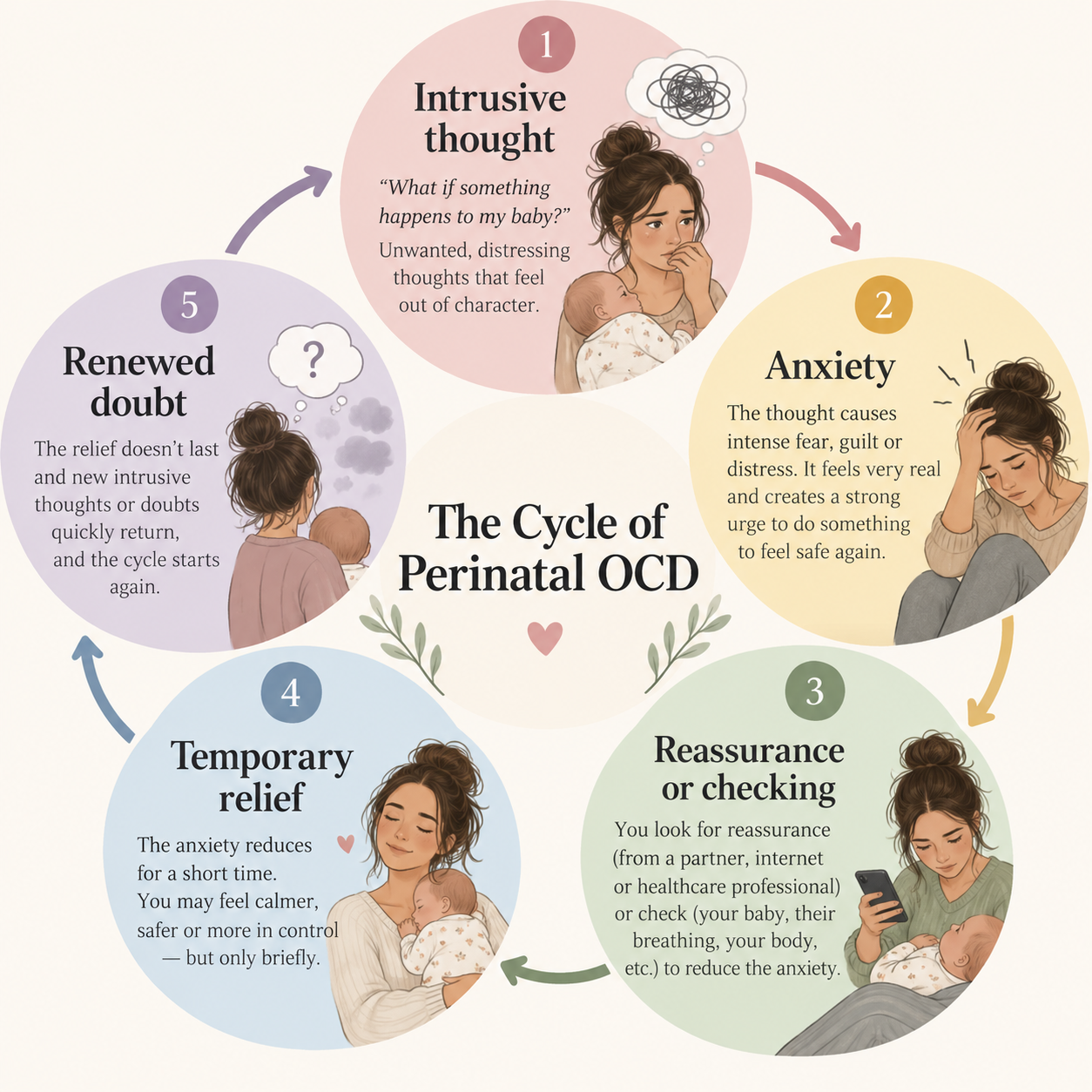
Intrusive thought → Anxiety → Reassurance or checking → Temporary relief → Renewed doubt
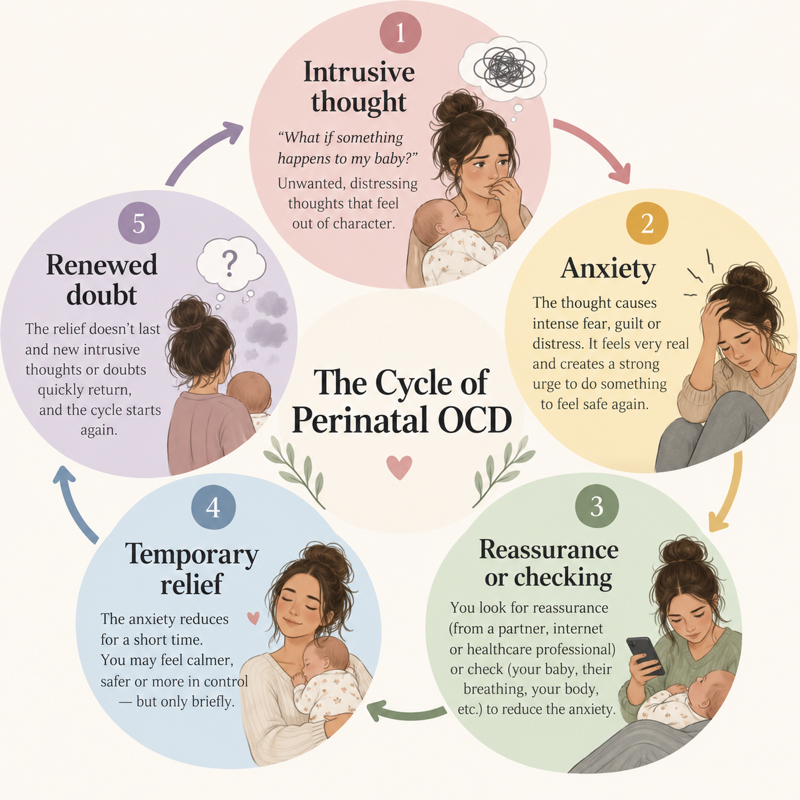
- Intrusive thought. “What if something happens to my baby?” Unwanted, distressing thoughts that feel out of character.
- Anxiety. The thought causes intense fear, guilt or distress. It feels very real and creates a strong urge to do something to feel safe again.
- Reassurance or checking. You look for reassurance (from a partner, internet or healthcare professional) or check (your baby, their breathing, your body, etc.) to reduce the anxiety.
- Temporary relief. The anxiety reduces for a short time. You may feel calmer, safer or more in control — but only briefly.
- Renewed doubt. The relief doesn’t last and new intrusive thoughts or doubts quickly return, and the cycle starts again.
The sequence returns from renewed doubt to intrusive thought.
Each time reassurance temporarily reduces anxiety, the brain learns that the intrusive thought requires a response.
Over time, the need for certainty can become increasingly demanding.
There is an important difference between receiving helpful information and repeatedly seeking reassurance.
Learning about postpartum OCD can help someone understand their symptoms and seek appropriate treatment. However, repeatedly searching for certainty about what an intrusive thought means may become part of the OCD cycle.
The goal of treatment is not to convince someone that a feared event is impossible.
Instead, it helps them change how they respond to uncertainty, intrusive thoughts, and uncomfortable emotions.
How ERP Therapy Helps Treat Postpartum OCD
Exposure and Response Prevention (ERP) is a specialized form of Cognitive Behavioral Therapy (CBT) and is considered a first-line psychological treatment for OCD.
ERP helps individuals gradually face feared thoughts, situations, and uncertainty while reducing the compulsive behaviors that maintain anxiety.
When treating postpartum OCD, the process is collaborative, individualized, and sensitive to the demands of caring for a newborn.
Step 1: Understanding Your Intrusive Thoughts
Treatment begins with a comprehensive assessment.
Your therapist explores the nature of your intrusive thoughts, how you interpret them, and what you do to manage the anxiety they create.
This includes identifying less obvious compulsions, such as mentally reviewing memories, analyzing feelings, or repeatedly seeking reassurance.
Your therapist also assesses for other postpartum mental health conditions to determine the most appropriate treatment.
Step 2: Identifying Avoidance and Compulsions
Many mothers experiencing postpartum OCD begin avoiding ordinary caregiving activities.
They may feel uncomfortable bathing their baby, preparing meals, or being alone with their child.
Others continue these activities but experience significant anxiety and engage in mental rituals.
Together, you and your therapist identify the behaviors that have gradually begun interfering with your daily life.
Step 3: Gradually Facing Feared Situations
ERP involves developing exercises that help you approach situations you’ve been avoiding.
For example, a mother who avoids bathing her baby because of intrusive thoughts might gradually work toward participating in ordinary bath-time routines.
The goal is not to create danger or disregard appropriate infant safety precautions.
Rather, it is to help the mother engage in normal caregiving without allowing OCD to dictate her behavior.
Step 4: Changing Your Response to Intrusive Thoughts
An essential part of ERP is response prevention.
Instead of repeatedly analyzing a frightening thought, seeking reassurance, or attempting to eliminate anxiety, you practice allowing the thought to exist without engaging in compulsions.
You might notice an intrusive thought and return your attention to caring for your baby rather than trying to determine what the thought means.
Over time, your brain can learn that an intrusive thought does not require an immediate response.
The goal isn’t to eliminate every unwanted thought. It’s to change your relationship with those thoughts so they no longer control your life.
Can Virtual ERP Therapy Help With Postpartum OCD?
Yes. ERP can be delivered effectively through virtual therapy when clinically appropriate.
For many new mothers, attending in-person appointments can feel overwhelming.
Between feeding schedules, sleep deprivation, childcare responsibilities, and physical recovery, finding time for therapy may seem nearly impossible.
Virtual ERP allows treatment to take place in your everyday environment.
This can be particularly helpful because many postpartum OCD triggers occur during ordinary caregiving activities.
With guidance from a specialized therapist, treatment can address real-life situations while helping you build confidence in responding differently to intrusive thoughts.
Finding Support for Postpartum OCD
Motherhood can bring moments of joy, exhaustion, uncertainty, and vulnerability.
When intrusive thoughts become persistent and frightening, they can make even ordinary moments with your baby feel overwhelming.
You may begin questioning yourself, avoiding situations, or feeling ashamed of experiences you haven’t shared with anyone.
But unwanted intrusive thoughts are not the same as intentions.
And experiencing postpartum OCD does not prevent you from being a loving, capable parent.
With appropriate treatment, it is possible to reduce compulsions, regain confidence in everyday caregiving, and develop a healthier relationship with intrusive thoughts.
Specialized Postpartum OCD Therapy at EK Mental Health Counseling
At EK Mental Health Counseling, we specialize in treating OCD, including perinatal and postpartum OCD.
Our approach incorporates evidence-based treatments, including Exposure and Response Prevention (ERP), Cognitive Behavioral Therapy (CBT), and Acceptance and Commitment Therapy (ACT).
We understand how frightening and isolating intrusive thoughts can feel, particularly when they involve the people you love most.
Our goal is to provide a compassionate, nonjudgmental space where you can discuss these experiences openly and receive treatment tailored to your needs.
If intrusive thoughts, anxiety, or compulsive behaviors are interfering with your daily life, specialized treatment can help.
Contact EK Mental Health Counseling to learn more about postpartum OCD therapy and schedule an initial consultation.
- Phone: 917-500-3995
- Email: info@ekmentalhealthcounseling.com
- Website: ekmentalhealthcounseling.com
Frequently Asked Questions About Postpartum OCD
Does having intrusive thoughts after childbirth mean I have postpartum OCD?
Not necessarily. Unwanted intrusive thoughts can occur after childbirth without indicating OCD. An assessment can help when thoughts cause persistent distress or lead to repeated checking, reassurance-seeking, avoidance, or mental rituals that interfere with everyday life.
Source: International OCD Foundation
What is the main difference between postpartum OCD and postpartum psychosis?
Postpartum OCD typically involves unwanted thoughts that feel inconsistent with the person’s values, often followed by compulsions or avoidance. Postpartum psychosis can involve hallucinations, delusions, confusion, and an altered understanding of reality. Distress alone does not distinguish them; a clinician considers the full presentation. Suspected postpartum psychosis requires immediate medical evaluation.
Source: International OCD Foundation
Can postpartum OCD involve compulsions that other people cannot see?
Yes. Compulsions may include mentally reviewing events, analyzing feelings, repeating phrases silently, or reassuring yourself. These internal rituals can serve the same purpose as visible checking: trying to reduce distress or gain certainty about an unwanted thought.
Source: International OCD Foundation
How does ERP help with postpartum OCD?
Exposure and Response Prevention (ERP) helps people approach feared thoughts and situations while reducing compulsive responses. Treatment is planned collaboratively with a trained therapist and respects appropriate infant-safety precautions. The aim is to change how you respond to intrusive thoughts and uncertainty, rather than eliminate every unwanted thought.
Source: International OCD Foundation
When should postpartum symptoms receive emergency attention?
Hallucinations, delusional beliefs, severe confusion, or sudden major changes in mood and behavior after childbirth require urgent medical attention. If postpartum psychosis is suspected, seek immediate emergency evaluation rather than waiting for a routine therapy appointment.
Emergency Mental Health Resources
If you or someone you know is experiencing hallucinations, delusions, severe confusion, or other symptoms suggesting postpartum psychosis, seek immediate emergency medical care.
If there is immediate danger, call 911 or go to the nearest emergency department.
Additional support is available through:
- 988 Suicide & Crisis Lifeline: Call or text 988 for 24/7 crisis support.
- National Maternal Mental Health Hotline: Call or text 1-833-TLC-MAMA (1-833-852-6262) for free, confidential, 24/7 support during pregnancy and postpartum.
These resources provide support and referrals but do not replace emergency evaluation when postpartum psychosis is suspected.